Driving on any underinflated tire is dangerous and may result in
sudden tire destruction caused by excessive heat build-up. For
replacement tires, your tire retailer should provide you with the
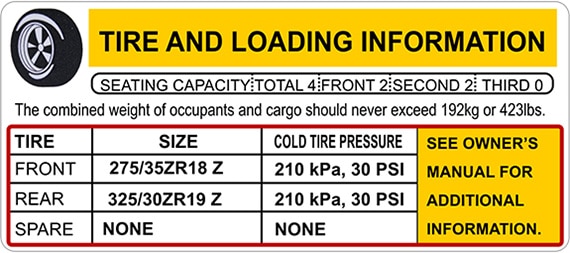
proper inflation pressure. Otherwise, follow the air pressure
recommendation found within your vehicle`s owner manual or tire
placard in your vehicle. If your replacement tire size is different
from the original equipment tire size, ask your tire retailer for a
revised air pressure recommendation guide in order to adequately
support your vehicle`s gross vehicle weight rating
Check the cold inflation pressure in all of your tires, including
the spare tire, at least once every week and always prior to long
distance trips. Failure to maintain the proper air inflation
pressure may result in improper vehicle handling and may cause rapid
and irregular tire wear, reduction in tire durability, loss of
vehicle control, or sudden tire failure that may lead to property
damage, serious personal injury or death.
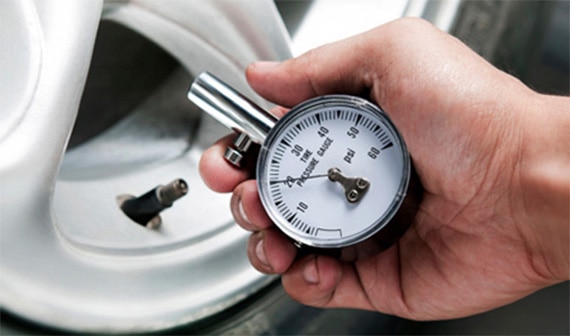
Use an accurate tire gauge to check tire air pressures. Always
maintain the proper recommended air inflation pressure in all tires.
If there is an indication that one of your tires has lost four or
more pounds of air pressure, immediately look for signs of
penetration through the tire, valve leaks or wheel damage that may
account for the air loss. You should also have your tires inspected
by a tire retailer immediately.
Air pressure should be checked when tires are cold (before they have been
driven), ideally in the early morning. Driving, regardless of distance, causes
tires to heat up and simultaneously increase air pressure.
Never exceed the maximum inflation pressure for the tire.
Never bleed air from hot tires as this may result in
under-inflation.
Inspect your tires daily. If you notice any damage to your tires or
wheels, replace them with a spare and immediately visit any tire
retailer for advice. Driving over potholes, curbs, wood debris,
metal, etc., can damage a tire and should be safely avoided. Contact
with such hazards requires an immediate and thorough tire inspection
by your tire retailer.
Always examine your tires for penetrations, bulges, cracks, cuts and abnormal
wear - particularly at the tire edges - which may be caused by, for example,
vehicle misalignment or tire under-inflation. Failure to properly control a
vehicle when one or more tires are under-inflated may result in an accident. Use
of a damaged tire may result in rapid air loss, including sudden tire failure.an
immediate and thorough tire inspection by your tire retailer.
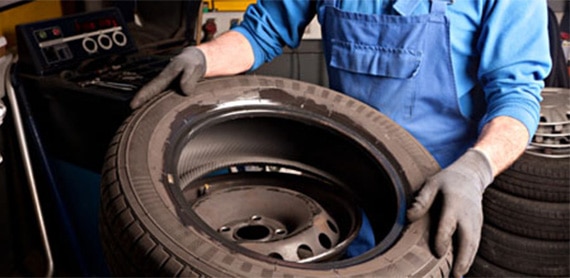
An explosion of the tire/rim assembly may occur because of improper mounting.
Only specially trained persons should mount tires.
Failure to store tires in accordance with the following
recommendations may result in damage to your tires, reduction in
tire durability, or sudden tire failure.
Tires should always be stored in a cool, dry, clean, indoor
environment. Tires contain waxes and emollients to protect their
outer surfaces from ozone and weather cracking. As the tire rolls
and flexes, the waxes and emollients continually migrate to the
tire`s surface, replenishing this protection throughout the normal
and proper use of the tire. However, when tires sit outdoors and are
unused for an extended period of time, the tire surface become dry,
the tire may be susceptible to ozone and weather cracking, and the
casing becomes susceptible to flat spotting.
Surfaces on which tires are stored must be free from grease, gasoline and other
substances that could deteriorate the rubber.
A qualified technician should check all tires when the Kumho Tire U.S.A., Inc.
warranty policy period has lapsed, even if damage is not obvious.
Do not overload your tires. Driving on any overloaded tire is extremely
dangerous and may result in an accident causing property damage, serious
personal injury or death.
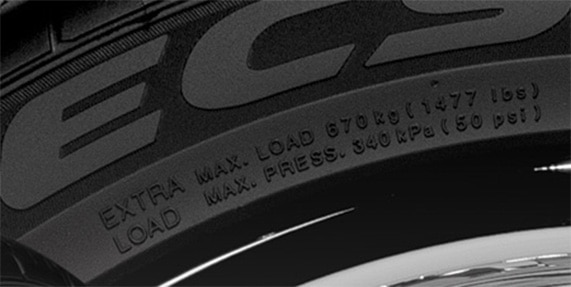
The maximum load rating marked on the sidewall of any tire is based on the
maximum speed of operation. Tires that are loaded beyond their maximum allowable
loads for a particular application will generate increased and excessive heat
that may cause sudden tire failure leading to property damage, serious personal
injury or death.
KUMHO NEWSLETTER
Rebates, new tires and race weekends. Straight to your inbox.
One email a month. New tire releases, current rebate offers and where Kumho is racing next. Unsubscribe any time.